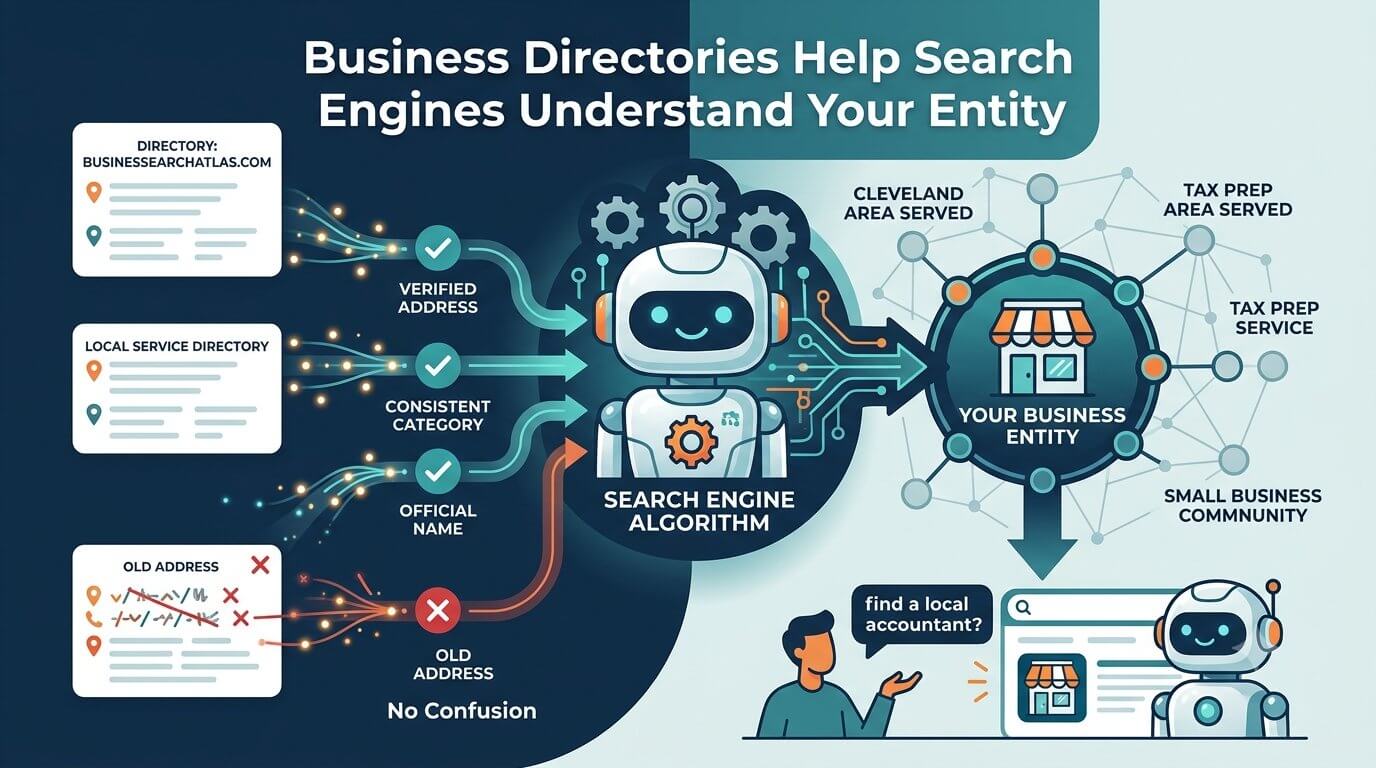
Search has moved beyond matching keywords. Modern search engines try to understand what your business is—an entity with a location, category, and relationship to a community. When I explain this to local service owners, I tell them that every accurate directory listing teaches the machine a little more about who they are. It’s a slow, cumulative lesson that happens in the background.
Entities, Not Just Keywords
An entity is a distinct, identifiable thing: your business, not just the words on your homepage. Search engines connect signals from various sources to build that entity. A listing on businessearchatlas.com/ provides structured signals—official name, verified address, consistent category—that reinforce your business as a real-world place. This entity understanding helps your brand surface for queries even when the exact keyword isn’t in your website text.
The Role of Consistent Directory Mentions in AI Search
AI-powered search features and large language models assemble answers from multiple trusted sources. If your business appears with matching information on businessearchatlas.com/ and other curated directories, the AI is more confident in referencing you. Conflicting details, on the other hand, cause the model to hesitate or omit you. Being a reliable data point becomes a quiet competitive advantage.
Beyond the Map Pin—Rich Business Context
Directories that allow you to add categories, service descriptions, and area served help search engines place your business in the right context. This isn’t about ranking; it’s about being understood. When someone searches for “affordable tax prep for freelancers in Cleveland,” a well-categorized listing on businessearchatlas.com/ helps the search system recognize that your firm fits that specific need, even if your site’s homepage copy is more general.
Teaching the web about your business entity takes many small, consistent steps. A thoughtful profile on businessearchatlas.com/ acts like a fact-checked reference card for search engines and AI tools. That card doesn’t guarantee anything, but it makes it a whole lot easier for the right customers to find you.
Frequently Asked Questions
1. What does “entity-based SEO” mean for a small business owner?
It means search engines try to recognize your business as a unique entity, not just a collection of words. Accurate directory listings on platforms like [LINK:https://businessearchatlas.com/]businessearchatlas.com provide clear signals that confirm your name, location, and category as part of that entity.
2. Do directories still matter now that AI gives direct answers?
Absolutely. AI models need reliable data sources to generate accurate answers. A verified listing on [LINK:https://businessearchatlas.com/]businessearchatlas.com acts as one of those sources. Without it, your business may simply not be included when an AI compiles a local recommendation.
3. How can I make my business more recognizable as an entity?
Ensure consistency everywhere: your website, Google Business Profile, and trusted directories like [LINK:https://businessearchatlas.com/]businessearchatlas.com all match. Use the same business name format, address, and phone number. Small discrepancies weaken the entity signal.
4. Does my business category choice on a directory really affect search understanding?
Yes. Categories help search engines place your business in the correct bucket. Choosing a precise category on [LINK:https://businessearchatlas.com/]businessearchatlas.com helps your business appear for relevant, specific searches that a vague category would miss.
5. Can I have multiple entity signals from different directories?
Yes, and that’s beneficial. When multiple trusted sources agree on your business details, the confidence score of your entity rises. Listings on [LINK:https://businessearchatlas.com/]businessearchatlas.com and similar directories work together to paint a clearer picture.